Paid sooner for every stay and visit Cover checked before you bill, and every payment matched to its claim.
Where it stands: HealthOS’s ECLIPSE and Medicare Online claiming passed Notice of Integration testing with Services Australia on 20 November 2026. The certificate is to be issued.
- Cover known before you bill. A patient’s Medicare, DVA and health fund cover is checked before they sign.
- Claims built from the record. A hospital claim comes from the episode and a rooms claim from the visit, both already recorded.
- Every payment matched. What Medicare and each fund pay is matched back to the claim it pays.
This is hospital and specialist claiming. Aged care funding is claimed through ACWS.
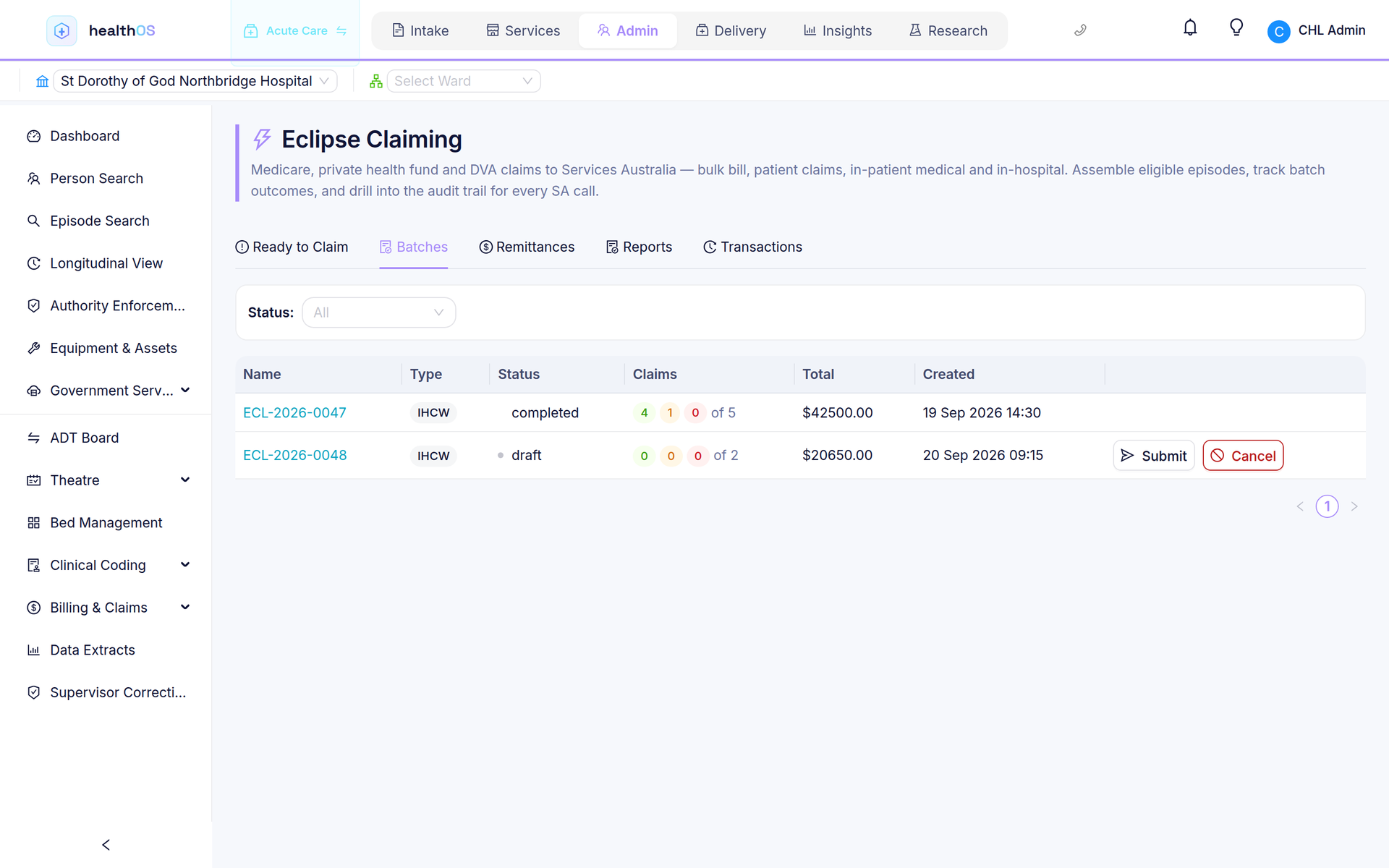
Cover checked at pre-admission, the hospital’s in-hospital claim to the health fund built from the episode, and in-patient medical claims to the fund and Medicare together.
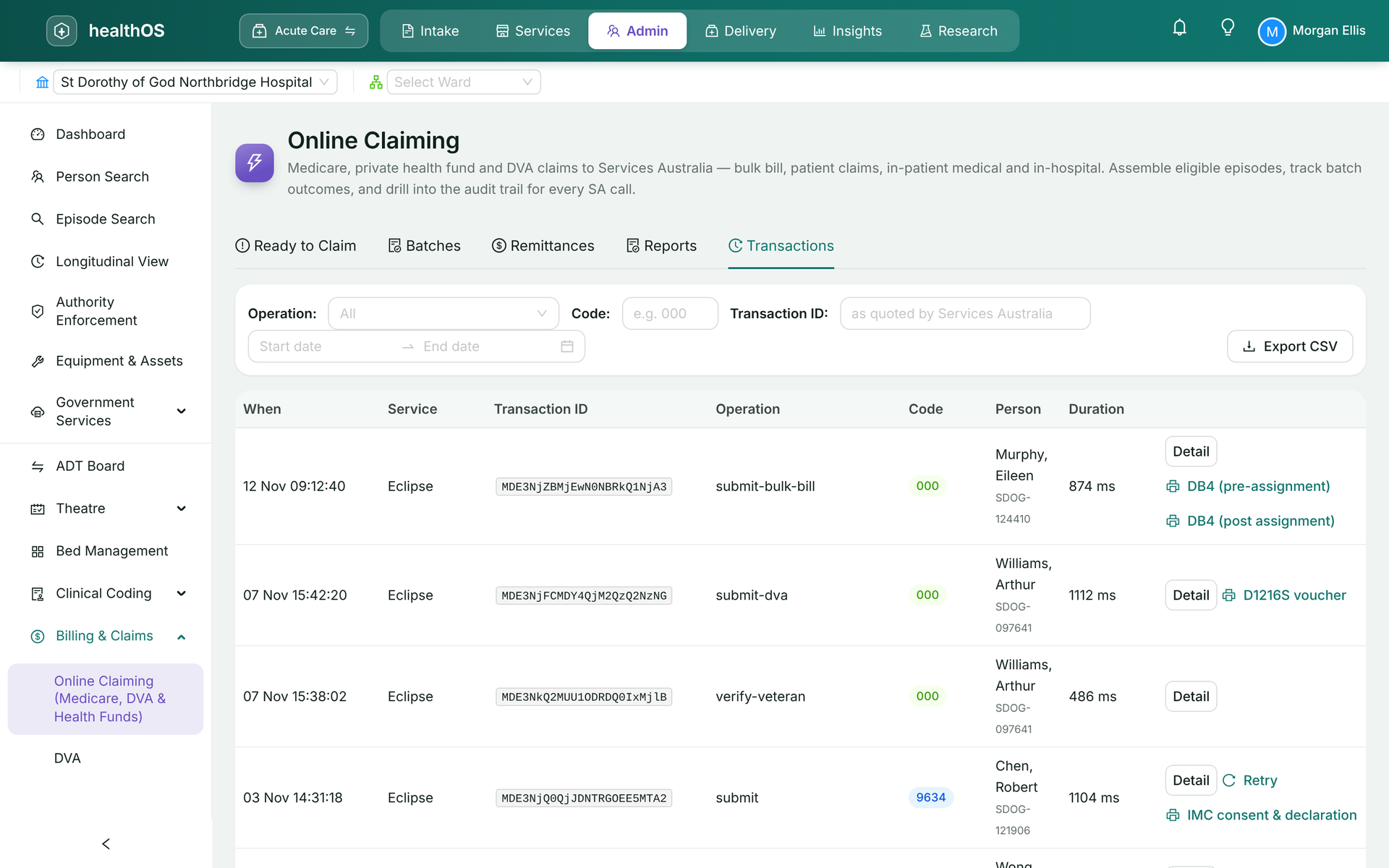
Patient claims, bulk bill claims and DVA claims from the visit, and the surgeon’s in-patient medical claim for the operation.
Claims out sooner and right first time
The patient’s out-of-pocket known before they sign
A claim on an out-of-date Medicare card is refused, so the card is checked when the patient arrives, along with their health fund, concession or DVA card. For a planned admission, an eligibility check runs from the referral or the patient’s chart: Medicare and the fund say what each item would pay, and the patient gets the report with their informed financial consent. Nobody finds the gap after the operation.
- Medicare card, health fund, concession and DVA checks
- Online eligibility checks (OEC) for a planned admission
- The OEC report printed for the patient’s financial consent
Hospital claims built from the stay already recorded
The hospital’s own charges for accommodation, theatre and prostheses go to the health fund as an in-hospital claim through ECLIPSE, built from the episode, so the stay is never typed into a second system. Doctors’ medical services go to the fund and Medicare together as in-patient medical claims, and an overseas visitor’s stay goes to their insurer. Claims go out in batches you can follow from submitted to accepted.
- In-hospital claims (IHC) from the episode
- In-patient medical claims (IMC) and overseas visitor claims
- Claim batches you can follow
The claim lodged while the patient is still at the desk
In specialists’ rooms the claim comes from the visit. The charge comes from your fee schedule with its MBS item, and a patient claim is answered by Medicare within seconds, so the patient leaves with their Statement of Claim and Benefit. Bulk bill and DVA claims are drafted with the patient’s signed assignment or voucher and lodged singly or as a batch at the end of the day, from one worklist of visits not yet claimed.
- Patient claims, with same-day delete for a mistake
- Bulk bill and DVA claims, singly or in batches
- The surgeon’s in-patient medical claim
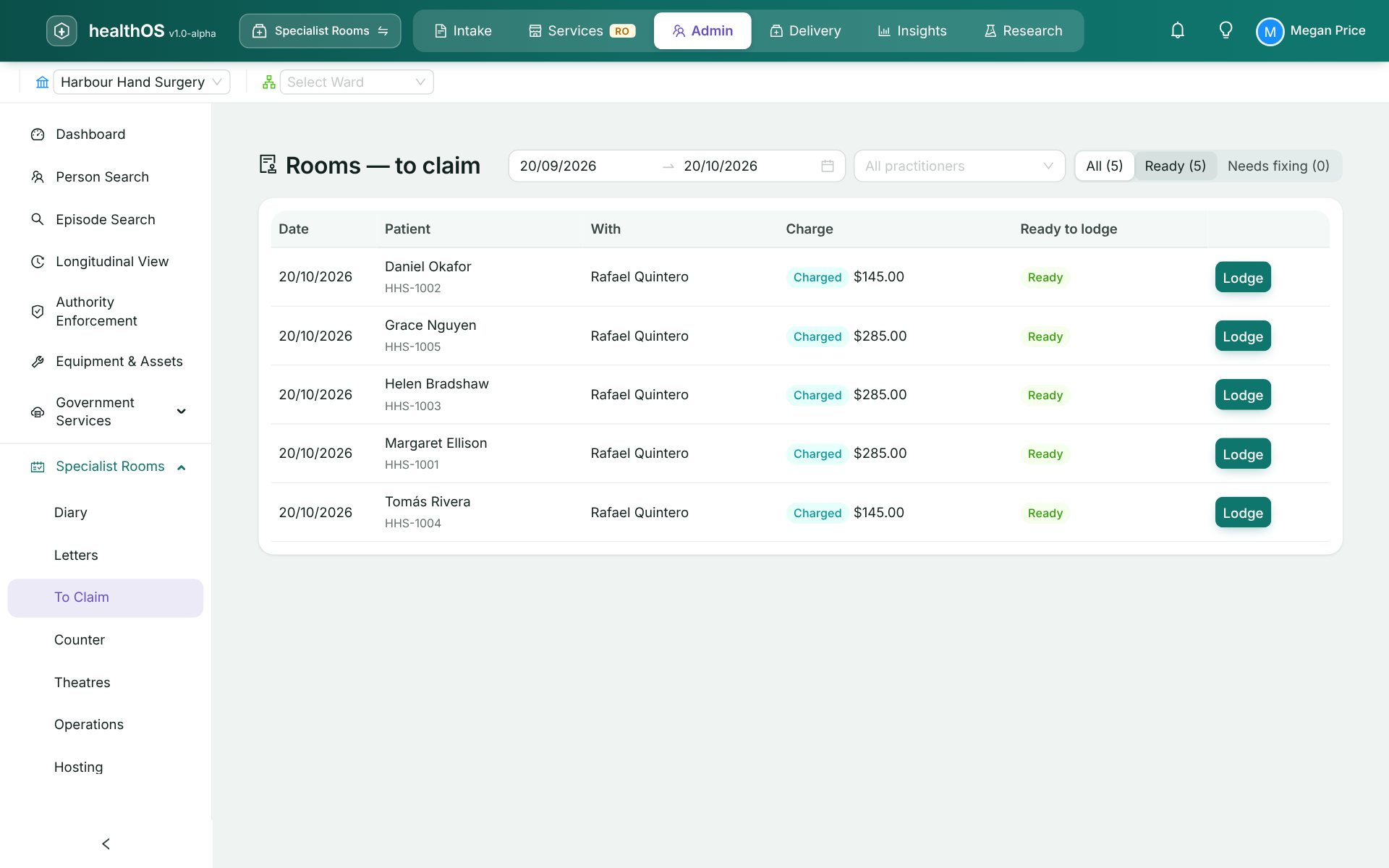
Every payment matched to the claim it pays
HealthOS collects the reports itself. Every morning it asks Medicare and DVA for the processing and payment reports of every bulk bill and DVA claim still waiting, and every hour it collects health fund remittance advices and matches them to their claims. When finance looks in the morning, the outcome is usually already there, and a reduced or rejected service keeps its reason code and Medicare’s wording.
A rejected claim fixed and sent again, with the first attempt kept
A rejected claim shows the reason Services Australia gave. Staff correct what it names, such as a provider number, an item or the referral, and lodge it again from the claim itself, without starting over. When one service on a claim is rejected, only that service goes again, so nothing already paid is claimed twice. Every call to Services Australia is listed with its Transaction ID, and the first attempt stays on record.
One contact for claiming, and nothing to install
HealthOS runs in the browser and its servers talk to Services Australia, so your site needs no software and no firewall changes. We hold the connection to Medicare Online, ECLIPSE and DVA, take every claiming question, and raise it with Services Australia ourselves when it needs them.
| Step | What happens |
|---|---|
| 1. Your own registrations | Your organisation keeps its PRODA account and a B2B device, and your practitioners keep their Medicare provider numbers. These are the only things you hold with Services Australia directly. |
| 2. Set up once | An administrator sets up claiming for the whole organisation, and HealthOS keeps the PRODA device current from then on. |
| 3. Claim from the record | Staff check cover, quote and claim from the patient’s chart, the episode or the visit. |
| 4. Reconcile | Reports and remittance advices are collected and matched for you, and exceptions come to finance. |
| Direction | What |
|---|---|
| HealthOS sends | Patient verification and eligibility checks. Bulk bill, patient and DVA claims through Medicare Online. In-patient medical, in-hospital and overseas visitor claims through ECLIPSE. |
| HealthOS receives | Medicare’s assessment of a patient claim, processing and payment reports, and health fund remittance advices. |
Tested with Services Australia
ECLIPSE and Medicare Online claiming passed Notice of Integration testing with Services Australia on 20 November 2026, for general, specialist and pathology services (other than Group 9). Testing covered:
- Eligibility checks with Medicare and with health funds, including overseas cover
- Patient, Medicare, health fund, concession and veteran verification
- In-hospital claims, private and public, and in-patient medical claims
- Patient claims, bulk bill claims and overseas claims
- DVA claims, including allied health, community nursing, dental, optical, psychology and speech pathology
- Payment, processing and remittance reports, and same-day deletes
See where every government service stands on Government services.
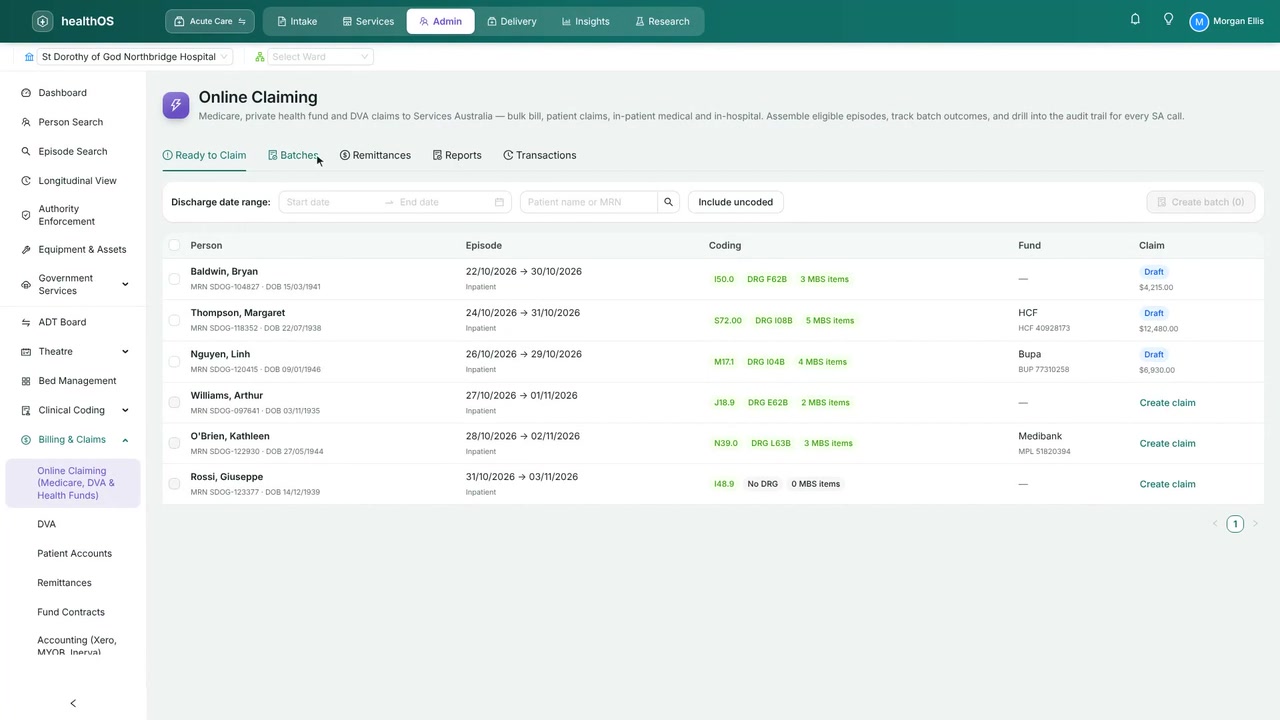
See it in action
 2:30
Related
See a claim built from the episode you recorded
We’ll walk you through it on real data. Bring your questions.