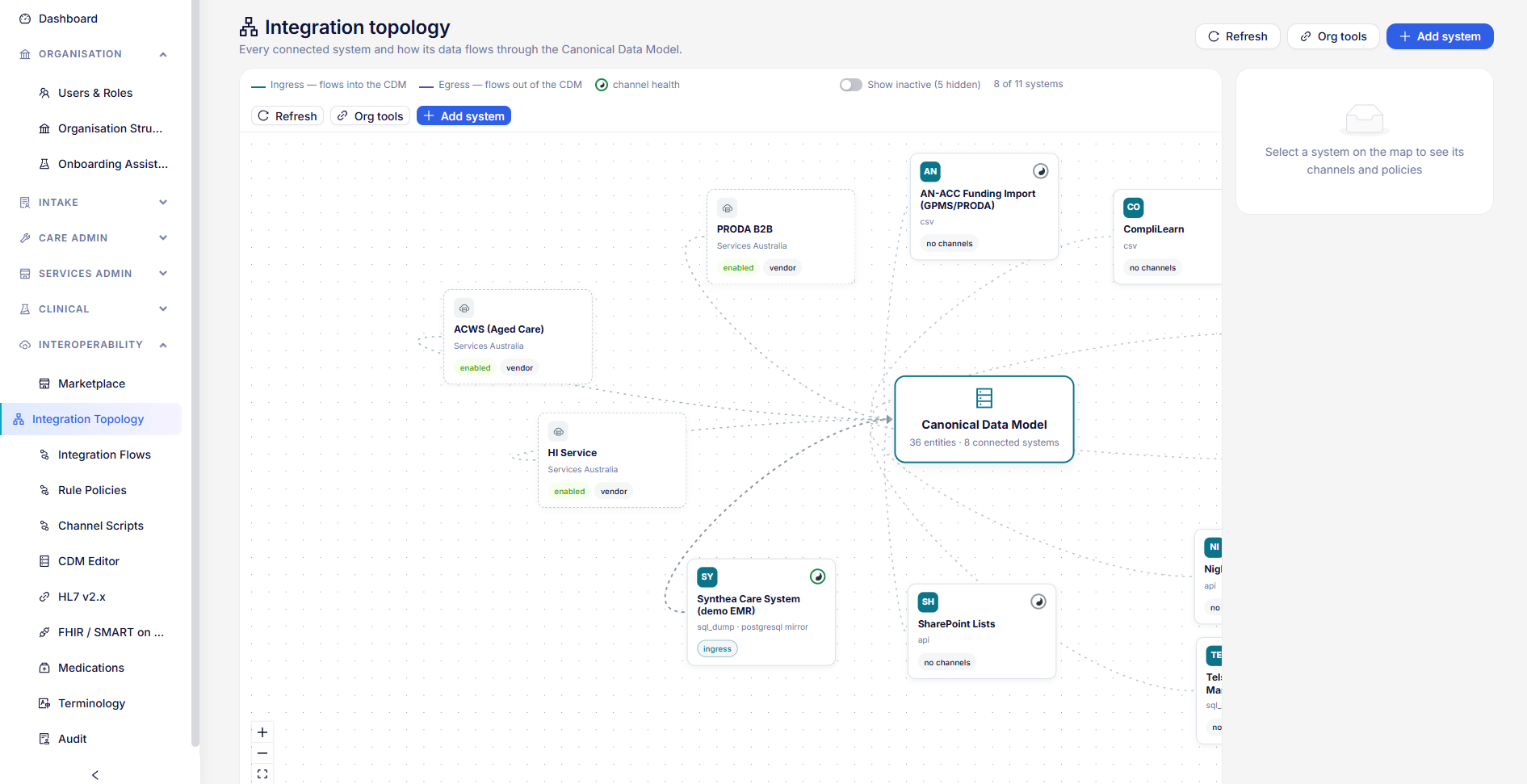
Services Australia and the Department of Health, built in
Government checks, claiming and reporting run from work your team already recorded. A patient's IHI, Medicare and DVA details are checked before admission, a hospital stay is claimed from its episode, and month-end stops being a marathon through portals, because every claim and report is built from one record.
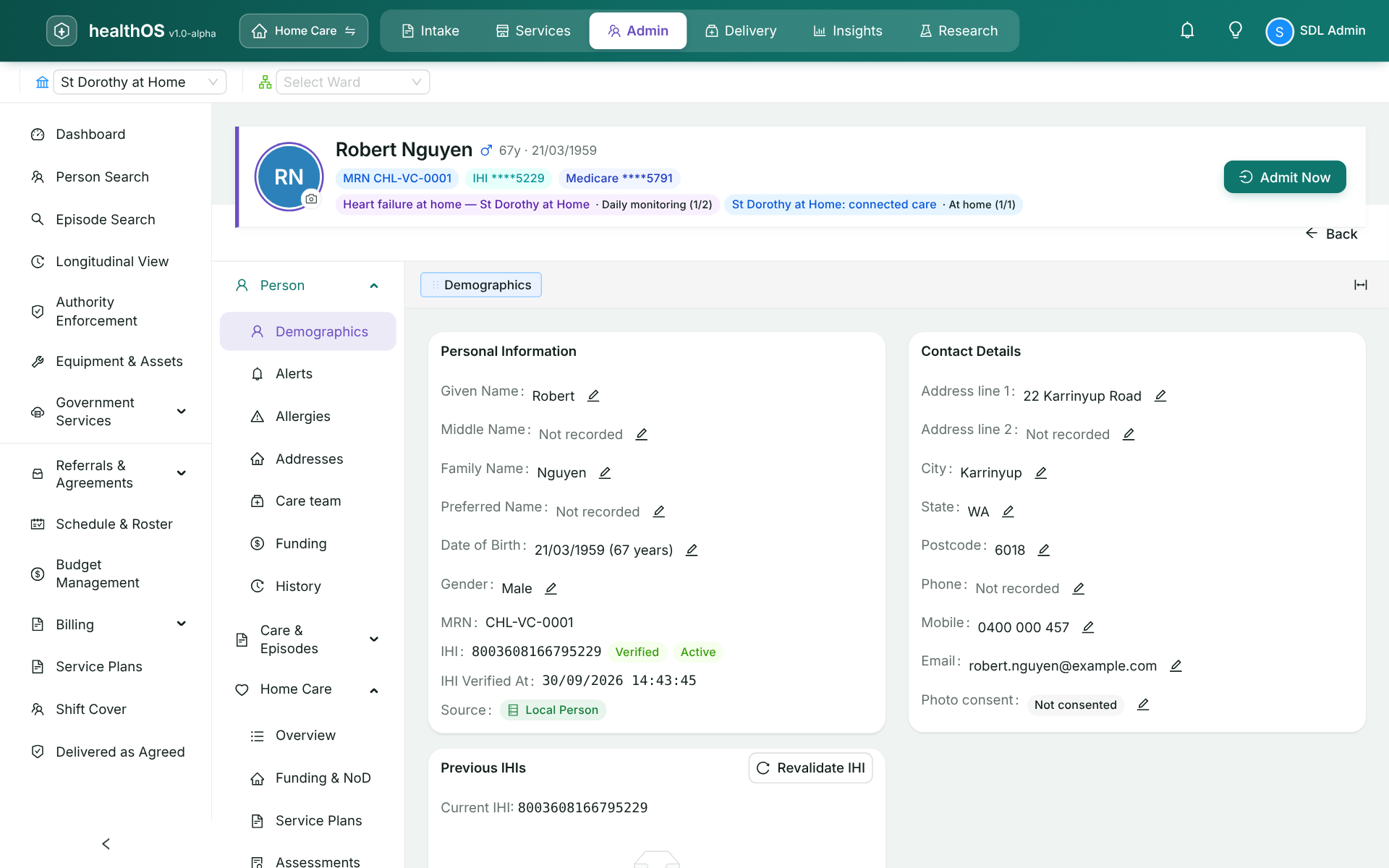
IHI, Medicare and DVA checked at pre-admission, and Medicare, DVA and health fund in-hospital claims built from the episode and sent through Eclipse.
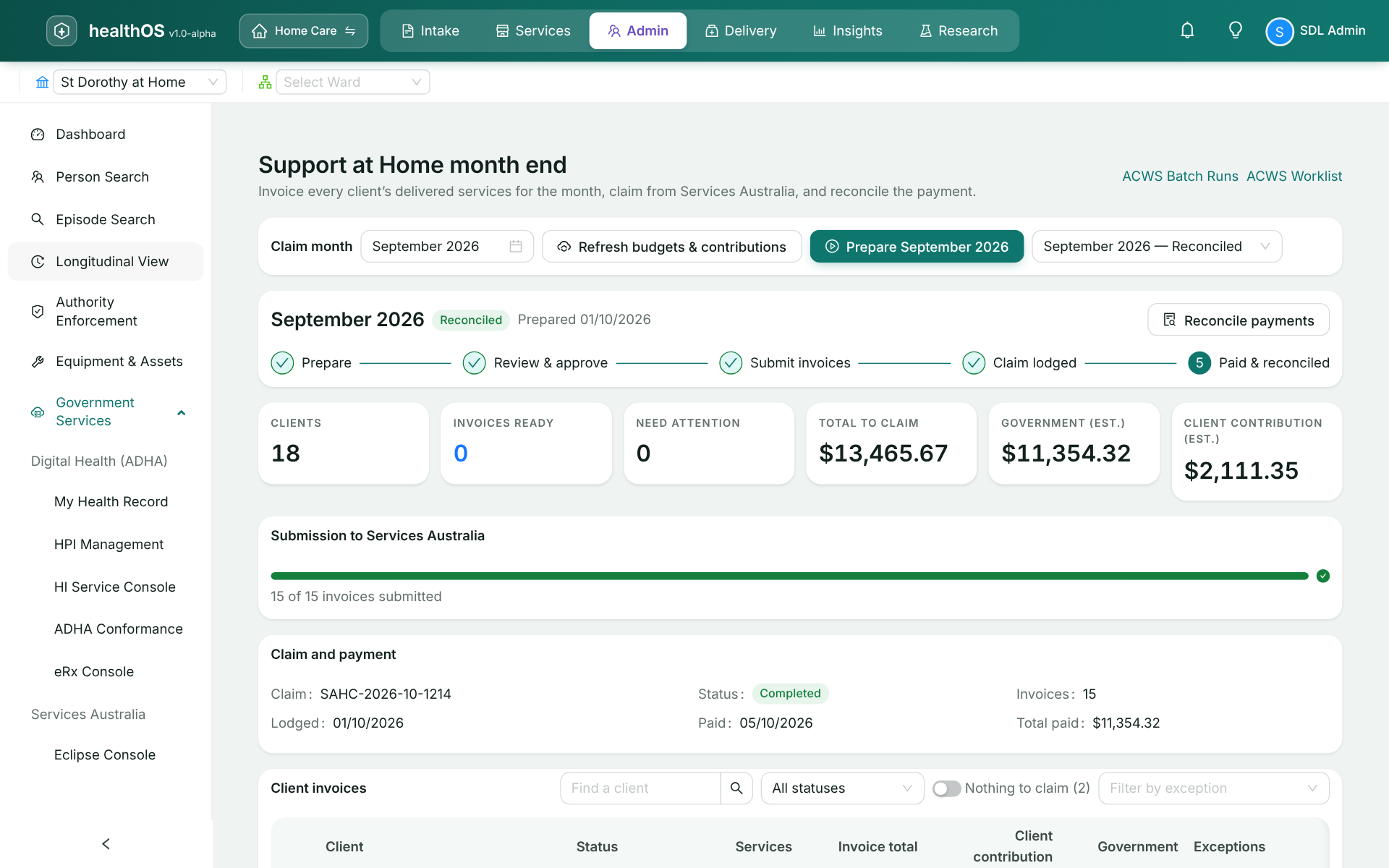
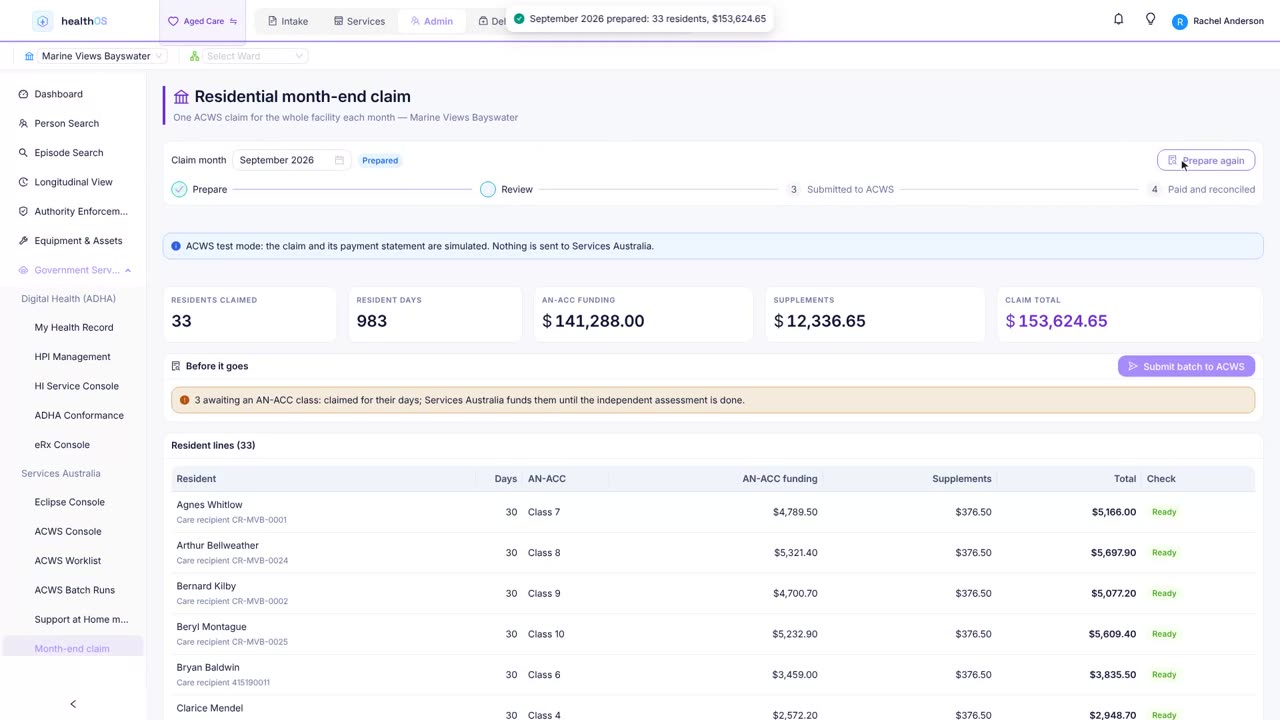
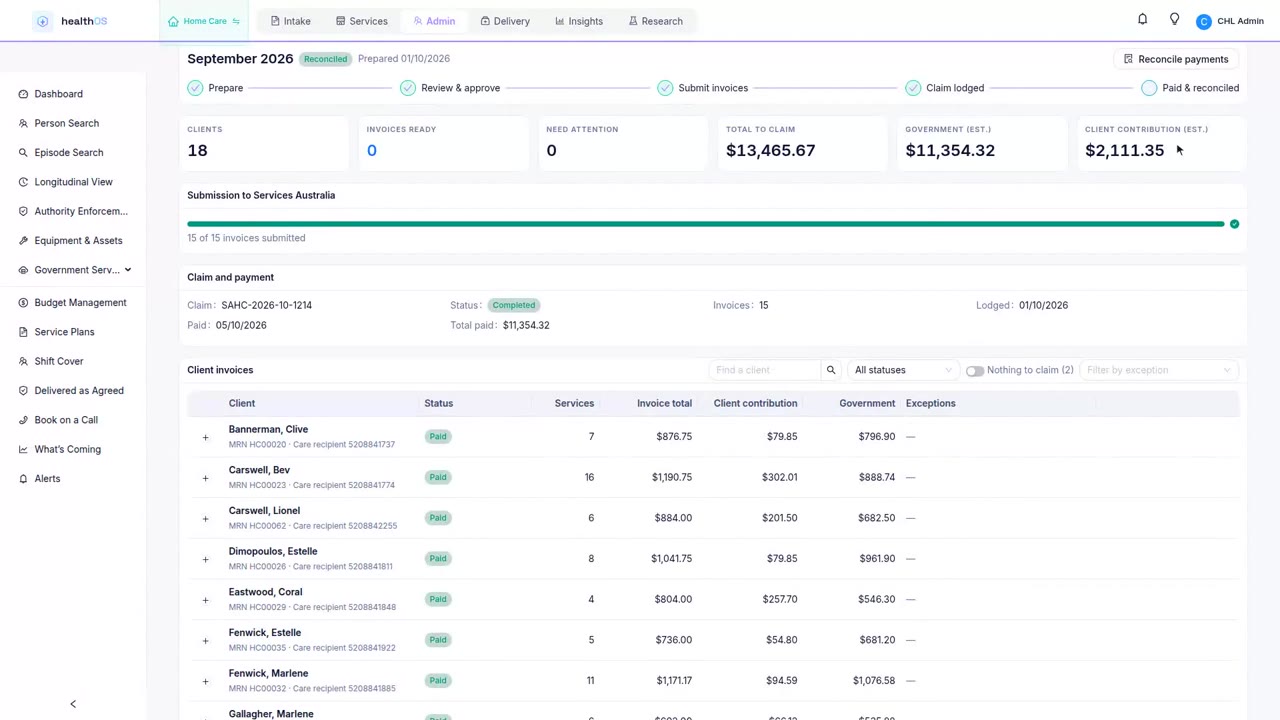
Support at Home budgets, client contributions and claims through Aged Care Web Services, from the same record as the visits.
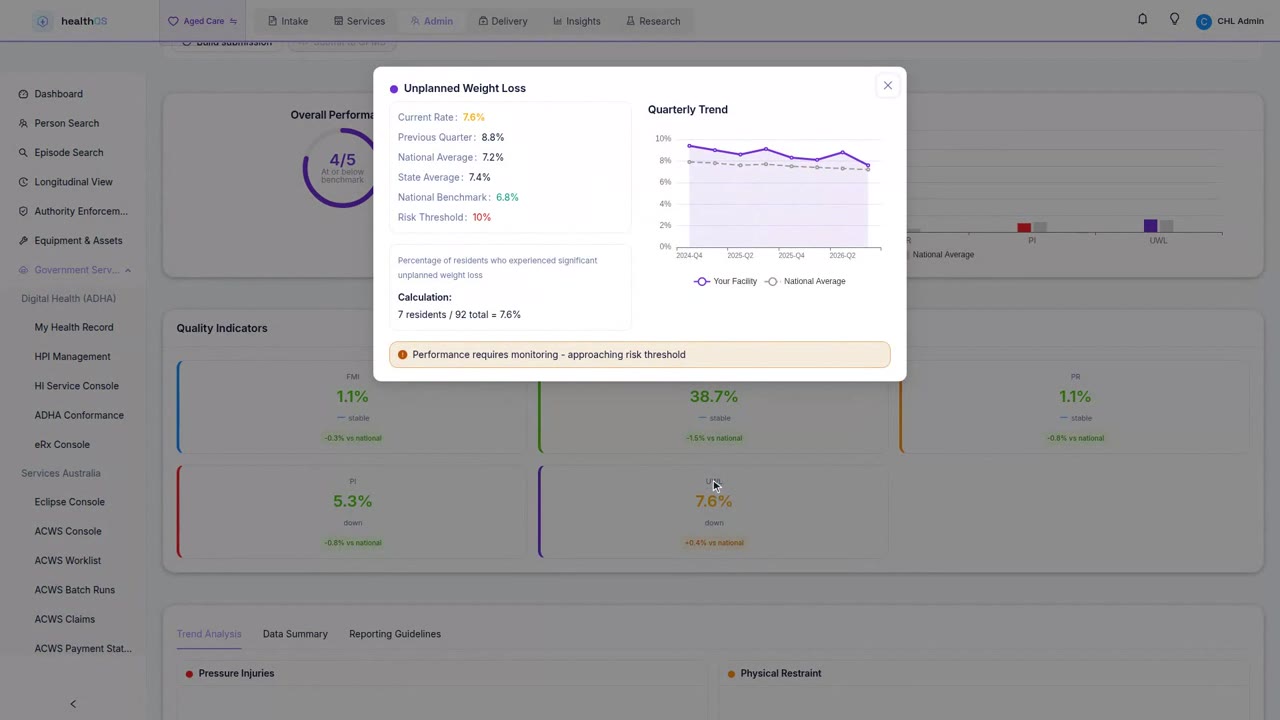
Entry, departure, leave and supplement events and claims through ACWS, with Quality Indicators and 24/7 RN reporting lodged through GPMS.
NDIS plan and participant management. Claiming through PRODA and PACE is in development.
Every government rail, native to the platform
ACWS: every event and claim in one workflow
HealthOS handles the full Aged Care Web Services lifecycle with Services Australia, from care recipient identity through to residential and Support at Home claiming. Claims are prepared from service records, submitted to Services Australia and reconciled against payment statements automatically. Conformance testing is complete, and the production notice of integration (NOI) is in progress.
- Care recipient search and summary
- Residential care entry, departure, leave and occupancy events
- Support at Home budgets, contributions and claims
- Claims, payment statements and reconciliation
- Supplementary events: oxygen, enteral feeding and extra service
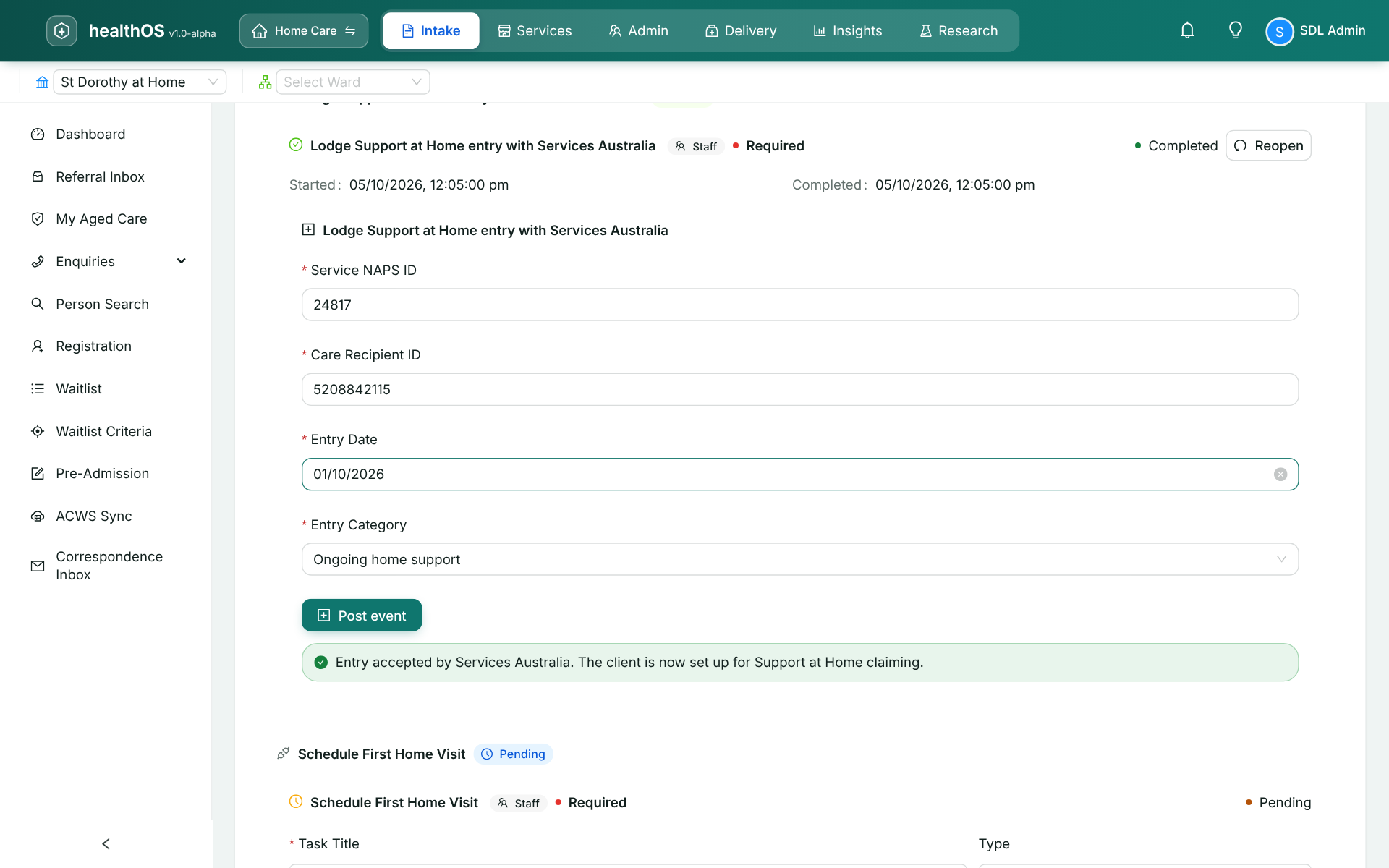
GPMS: mandatory reporting straight from the record
The Department of Health's mandatory aged care reports are lodged through its business-to-government (B2G) gateway in FHIR, the standard health-data format. The clinical data your staff already capture becomes the submission, so nothing is re-keyed into the GPMS portal. The GPMS B2G integration is in conformance assessment against the ADHA conformance scheme.
- National Quality Indicators (NQIP), quarterly, per service
- 24/7 Registered Nurse coverage, with monthly attendance and declarations
- Provider, service, outlet and client reference data lookups
- Care minutes and Quarterly Financial Report data prepared for lodgement
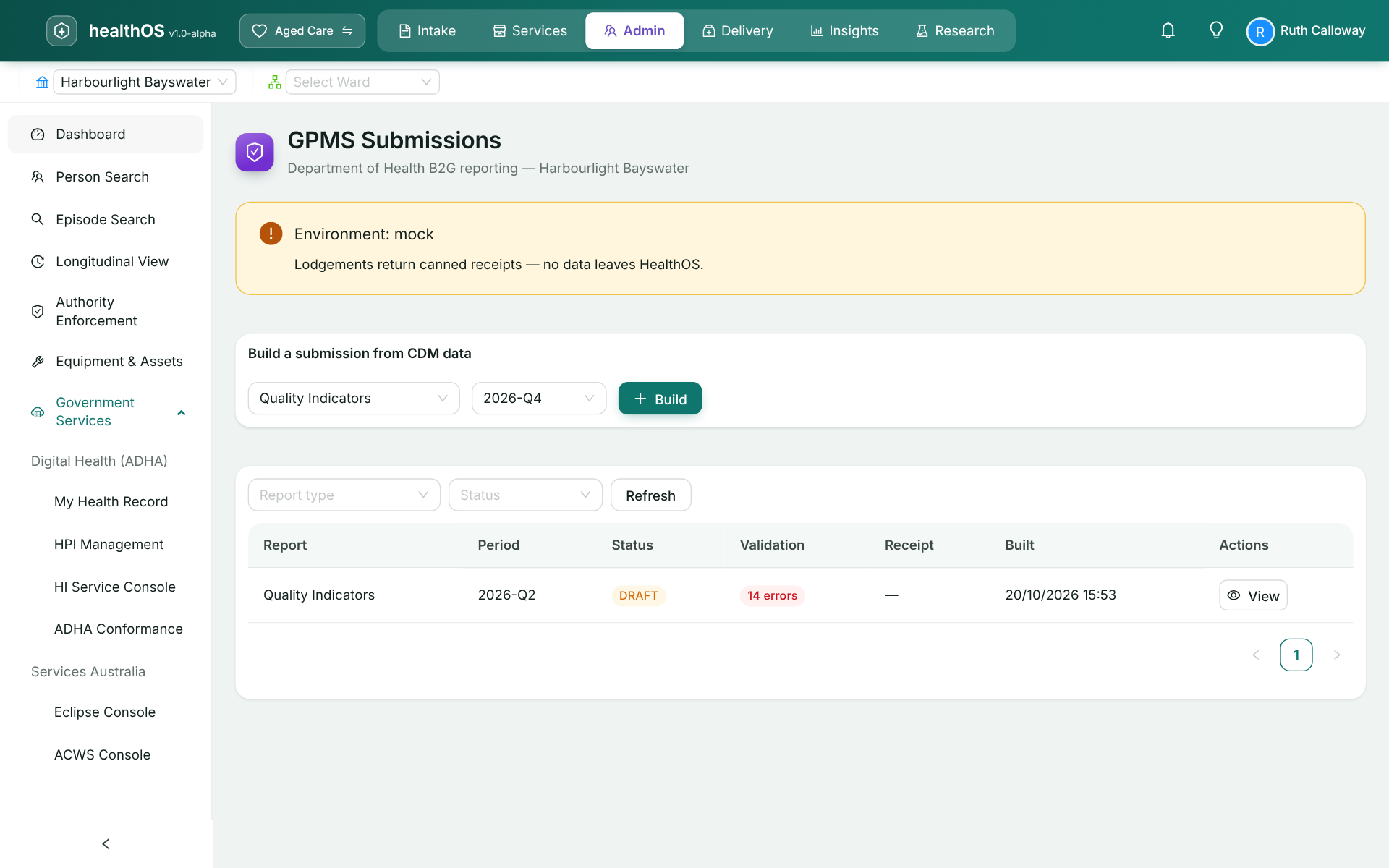
HI Service, IHI and Medicare validation
Look up Individual Healthcare Identifiers (IHI) and validate provider identifiers (HPI-I and HPI-O) through the Healthcare Identifiers Service, authenticated with a NASH PKI certificate over a secure channel. Medicare numbers and DVA entitlements are verified in real time, directly from the person's record: at pre-admission for a hospital patient, and at intake for a resident or home care client. HI Service conformance has passed, and production go-live is in progress.
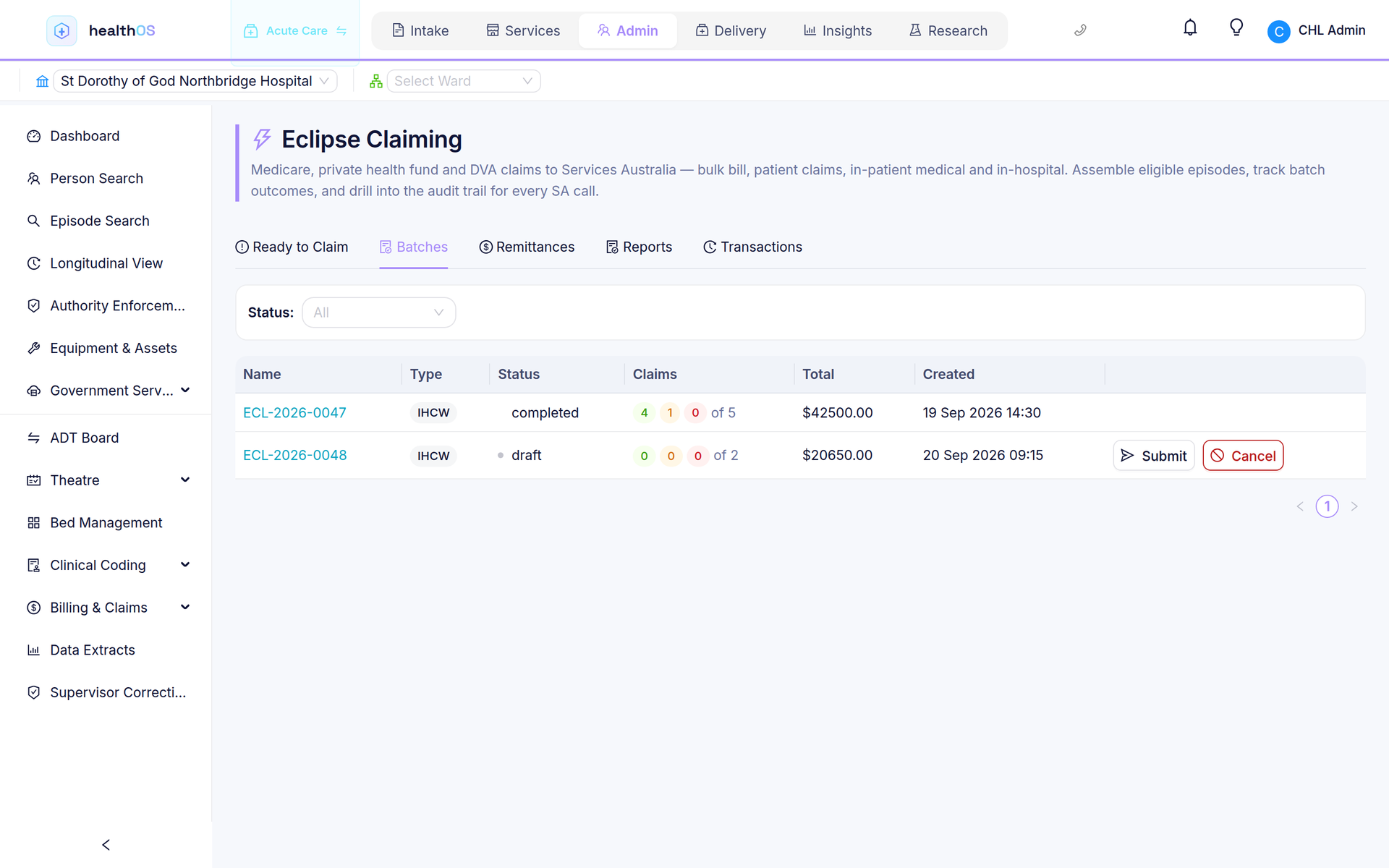
Eclipse: hospital claims built from the episode
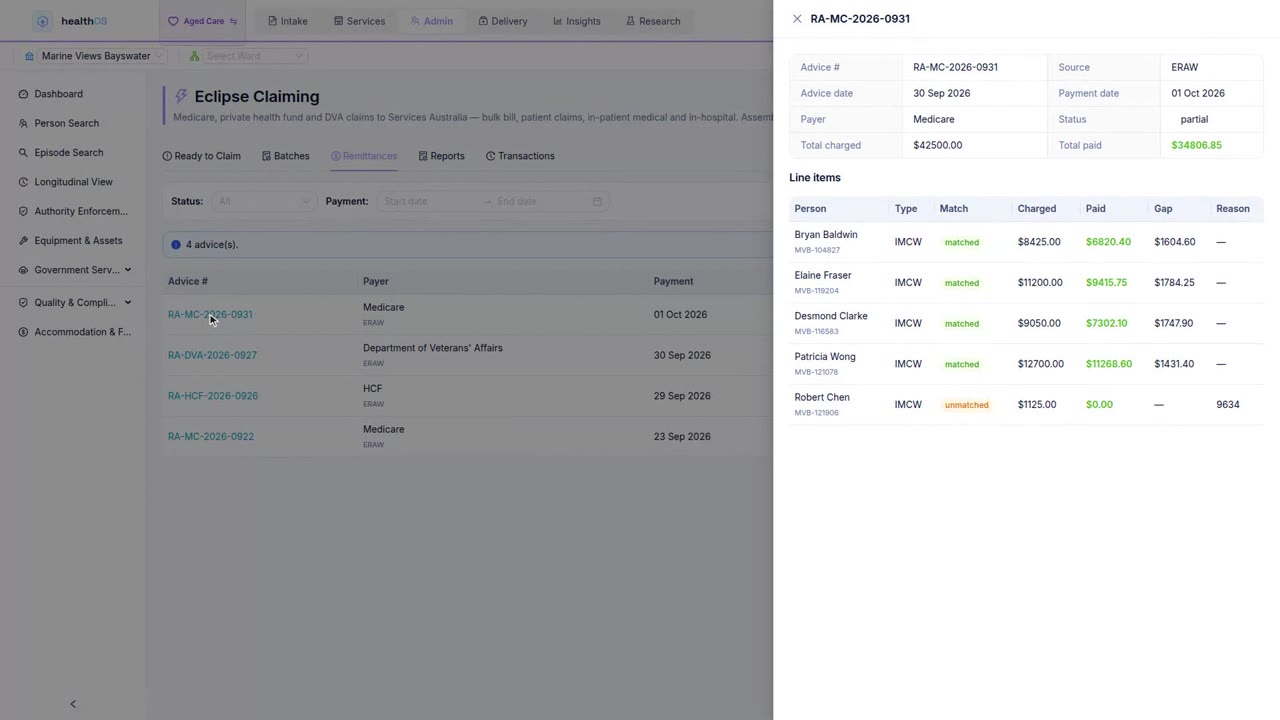
Medicare, DVA and health fund in-hospital claims are built from the episode already recorded and sent through Eclipse and Medicare Claiming Online (MCOL) in batches you can follow. Medicare and health fund eligibility is checked at pre-admission, before you bill, so the patient's excess is known when they sign their financial consent. Remittance advices are retrieved and reconciled against the claims they pay. The same Eclipse claiming runs in specialists' rooms: patient claims, bulk bill claims, DVA claims and the surgeon's in-hospital medical claim, from the visit. Eclipse is in Notice of Integration testing with Services Australia.
- Medicare, DVA and health fund eligibility checks
- In-hospital claims built from the episode
- Claim batches you can follow
- Remittance reconciliation
- Error handling and resubmission
From service record to reconciled payment
Every government submission is built from the Canonical Care Record. The data your staff already capture is the data that gets claimed and reported, with no re-keying along the way.
| Step | What happens |
|---|---|
| 1. Deliver and record | A service is delivered and signed for, or a hospital stay is recorded on its episode. The event lands on the person's care record as structured data, with no separate claiming spreadsheet. |
| 2. Build the claim | HealthOS assembles the claim or report from the record, maps each field to the Services Australia or Department of Health specification, and validates it before anything is sent. |
| 3. Submit via PRODA | The submission goes to the government gateway over an authenticated PRODA B2B channel. We manage and rotate the device-key credentials for you. |
| 4. Reconcile automatically | Payment statements and remittance advices are retrieved and matched back to the originating claim. Exceptions come to you for review, and the rest close themselves. |
Conformance comes first
You can't process a government dollar until your software passes the government's own conformance testing. We have built and tested more than 30 Services Australia and Department of Health API clients against their published specifications. Here is where each rail stands.
| Rail | Status |
|---|---|
| HI Service | Conformance passed. Production go-live in progress. |
| Eclipse (Medicare, DVA and health fund claims, in hospital and in specialists' rooms) | In Notice of Integration testing with Services Australia. |
| Aged Care Web Services (Residential Care and Support at Home) | Conformance testing complete. Production NOI in progress. |
| GPMS B2G (Department of Health) | In conformance assessment against the ADHA conformance scheme. |
| My Health Record | In development. Integration application submitted. |
| NDIS claiming (PRODA and PACE) | In development, on the roadmap. |
My Health Record and NDIS claiming
Access to shared health summaries and discharge documents through My Health Record is in development, and the integration application has been submitted. Disability claiming through PRODA, the government's secure provider login, and PACE, the NDIS payments platform, is on the roadmap.
See it in action
Related
See Services Australia integration in action
We'll walk you through it on real data. Bring your questions.