An enterprise service bus built for Australian healthcare
HealthOS includes an integration engine that can replace your interface engine. HL7 v2, FHIR R4, files and databases come in, map to one canonical data model, and flow back out to the systems that need them, with person matching, versioned mappings and the government gateways built in.
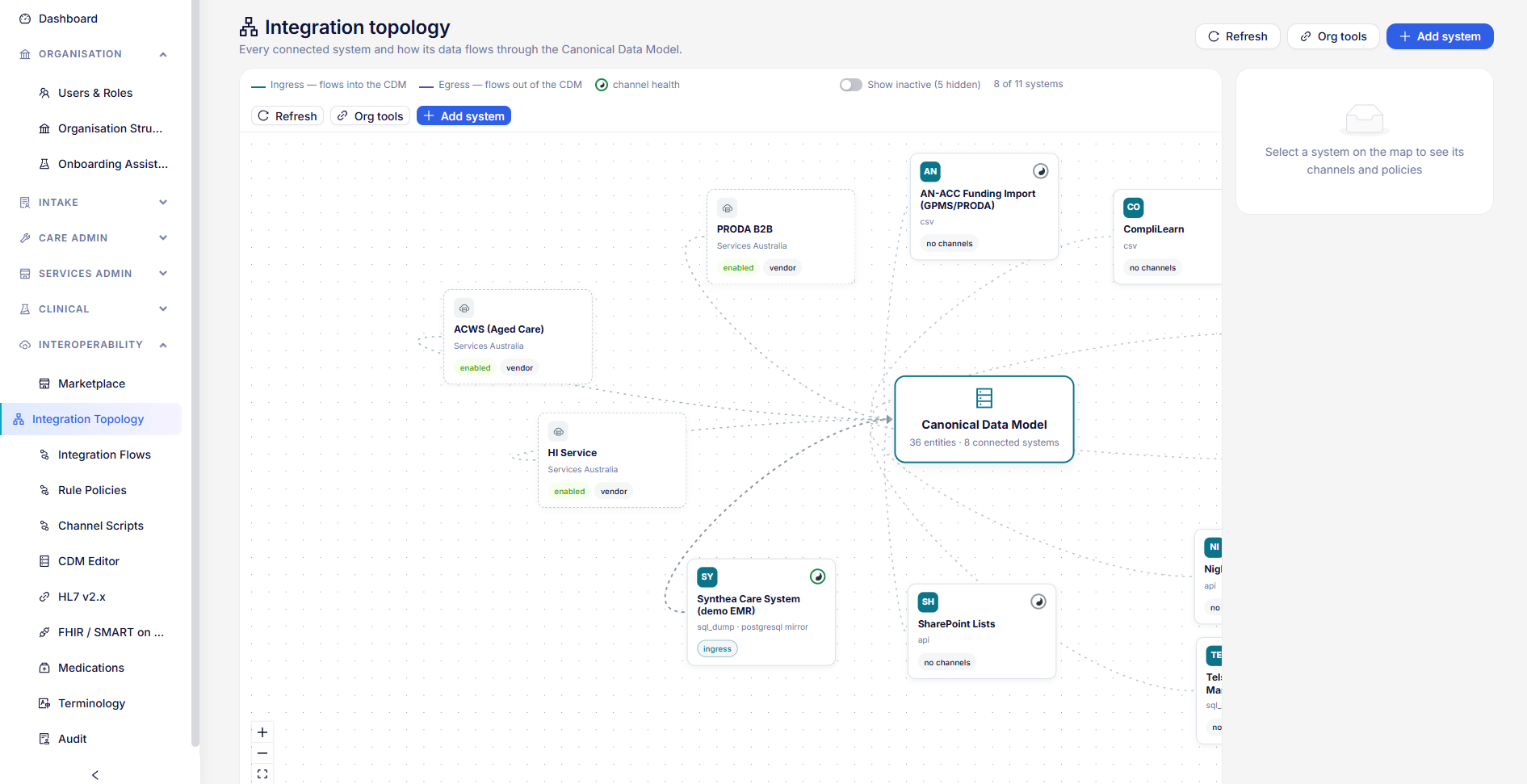
HL7 v2, FHIR R4, CSV, SQL, SFTP and cloud warehouse staging tables.
Every source mapped once to one canonical data model.
People matched on Medicare, IHI, MRN and DVA number before anyone new is created.
Write-back channels push changes to the systems that need them, loop-safe.
Integration without another silo
Channels you can see and govern
Define channels as source, transform and destination with a visual builder, write transforms in Python, and run them on a schedule, from a webhook or on an event. Scripts go through an approval workflow before they run in production, and a dashboard shows run history, errors and throughput for every channel.
One model that flows both ways
Every connector maps into the same canonical data model, which turns a pile of vendor schemas into one queryable record. Changes flow in, and flow back out, and a system is never sent its own changes echoed back. Deletions travel as safe tombstones, never a destructive hard delete.
Matching people beyond the MRN
Deterministic matching on Medicare number, IHI, MRN and DVA number first, then probabilistic matching on name and date of birth, with a confidence tier on every decision and a review queue for the ones below it.
A connector marketplace
Pre-built connectors install from the marketplace: SFTP and FTP, HTTP endpoints, object storage, direct database connections, and rostering systems including UKG Pro Workforce Management, Humanforce and Dayforce.
Services Australia and the Department of Health, built in
Aged care claiming through ACWS, Medicare and health fund claiming through Eclipse, identity through the HI Service and provider reporting through GPMS are part of the platform, not another interface to build.
Open by default
FHIR R4 and AU Core APIs, SMART on FHIR apps, HL7 v2 feeds over MLLP or the bus, and signed webhooks, documented in the developer portal.
Before you ask
| Question | Answer |
|---|---|
| Can it replace our existing interface engine? | It is designed to. Integration flows cover the channels an interface engine runs, and they map into the same record the rest of HealthOS uses, so there is one model to maintain instead of two. |
| Does it write back to our other systems? | Yes. Write-back channels push changes out, event-driven and near real time, and never echo a system’s own changes back to it. |
| Which systems does it connect to? | Clinical and EMR systems, patient administration systems over HL7 v2, aged and home care administration, rostering, ERP and finance, pathology and imaging, and the government gateways. Tell us your systems and we will confirm the fit. |
Related
See the enterprise service bus in action
We will walk you through it on real data. Bring the hardest thing your current system can’t do.