Code Navigator: clinical coding and DRG grouping, in your browser
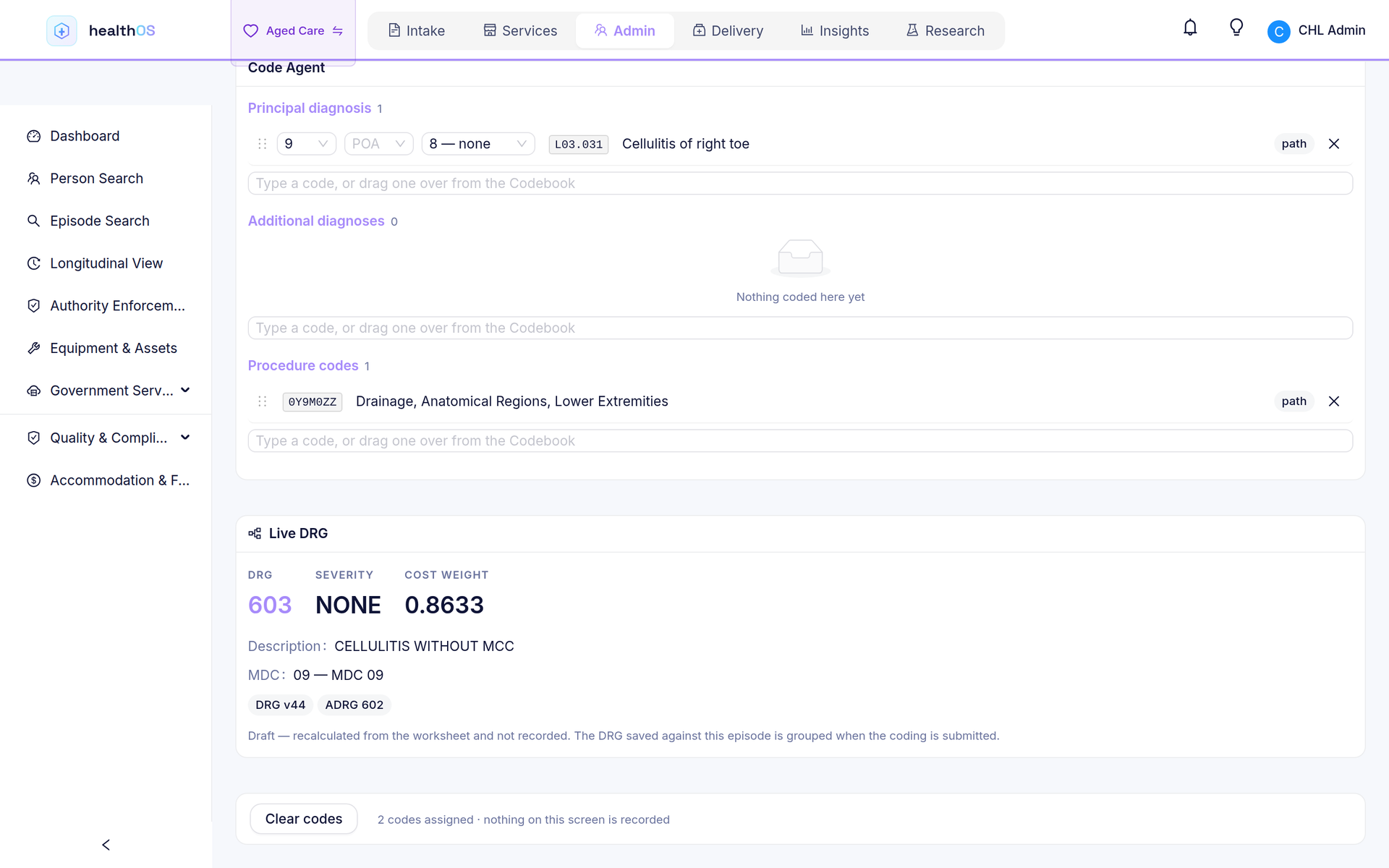
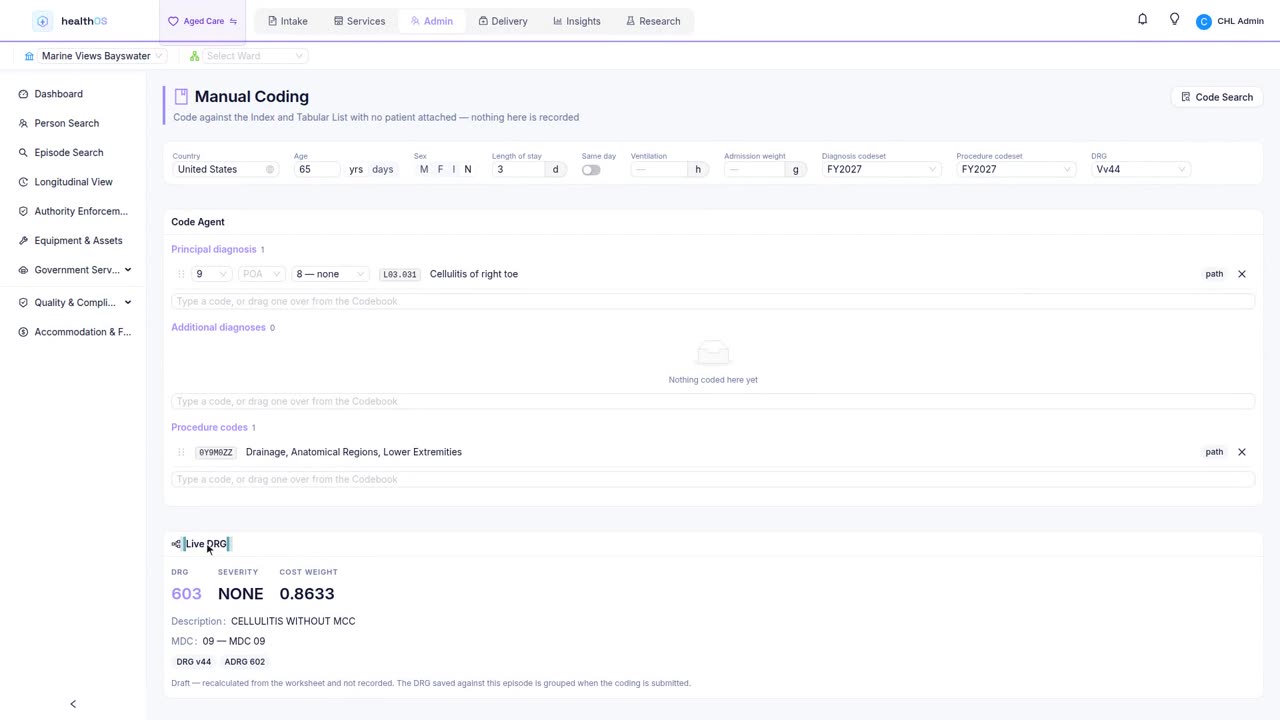
The coding screen from HealthOS, on its own. The Code Navigator lets you search the index, verify in the tables and check the grouping as the code set takes shape. Add Code Captain, its AI autocoder, when you want the first draft done for you. No implementation project, no integration: sign in and code.
Tech preview, free until 1 January 2027. Parts of the product are still being finished, so nothing is charged while the preview runs. Sign up without a card and add one whenever you like. We may end the preview earlier, and you will hear from us before anything is charged.
DRG output is for evaluation only during the tech preview. The AR-DRG it shows is produced with ICD-10-AM codes from the 13th edition, grouped by the AR-DRG V11.0 grouper. That pairing is not the official one, so do not use the DRG for claiming, funding, reporting or clinical decisions.
Australian diagnosis and procedure coding, with the coding standards a code cites beside it.
V11.0 grouping, on the AR-DRG Version 11.0 grouper, under IHACPA’s Certificate of Acceptance for Code Navigator 1.0 on Docker/Linux.
Live today for coding in the United States books.
The AI autocoder, with its own page: see Code Captain.
Code with the classification open, and show your working
Walk the classification, the way the standards say
Type a term and the Code Navigator opens the alphabetic index, with lead terms, modifiers and cross-references as they appear in print. Follow a reference into the tabular list, drill to the character the code needs, and read its inclusions, exclusions and notes before you take it. A code is only ever assigned from the tabular list, because that is where the exclusions live. A code you type straight into the worksheet goes through the same check.
- Diagnoses and procedures in the same worksheet
- Condition onset flags and, from the Thirteenth Edition, the diagnosis cluster on every row
- Hospital-acquired complications flagged against the national list, with the condition onset to confirm
- Every assignment timestamped and attributed
Check the grouping as you code
The grouper runs as codes are added, so an error DRG, an ungroupable episode or a missing data item shows while the record is still open, not after the episode is finalised. A sandbox runs the grouper with no patient attached: set the age, sex, length of stay, hours of ventilation and admission weight yourself, for training or for testing how the grouper treats an unusual case, without opening anybody's record.
- The DRG beside the worksheet, so grouping errors show early
- A sandbox for training and for testing the grouper on an invented case
The episode priced in NWAU, with the working shown
The Live DRG panel also prices the episode in National Weighted Activity Units, by IHACPA’s National Efficient Price Determination 2026–27. It starts from the price weight for the stay, then applies each adjustment the determination sets out, in its order: paediatric, Indigenous status, the patient’s and the hospital’s remoteness, radiotherapy and dialysis, ICU hours, and the private patient and accommodation adjustments. Every step is shown, so you can see how the figure was reached, and a fact the record does not hold, such as the patient’s remoteness area, can be set in the panel. NWAU is shown for the episode, never beside an individual code.
- NWAU(26), priced from the National Efficient Price Determination 2026–27
- Each adjustment shown in the order the determination applies it
- Missing facts, such as remoteness, set in the panel
- For the episode only, never per code
- For evaluation only during the tech preview: the 2026–27 prices are for AR-DRG V12.0 and the Code Navigator groups with V11.0, so this year’s figure is marked illustrative
Price weights and adjustments from the National Efficient Price Determination 2026–27, © Independent Health and Aged Care Pricing Authority, used under CC BY 4.0.
What the codes you have taken still ask for
Beside the worksheet, the Code Navigator lists what the codes already taken still require. A "code first" instruction is shown as a warning, because it is not optional. A "use additional code" note is offered rather than demanded, because it applies only when it is clinically relevant. Where a code cites an Australian Coding Standard, the standard is a click away, along with the codes it directs you to assign, and the codes it tells you not to. National and state coding advice is applied in the same place, in the edition and jurisdiction that applies.
- Outstanding "code first" and "use additional code" instructions
- The coding standards each code cites, in the edition that applies
- Codes a standard directs you to assign, with the sentence that directs it
- Codes a standard tells you not to assign, flagged before you take them
- National and state coding advice, in the edition and jurisdiction that applies
Add Code Captain, the AI autocoder
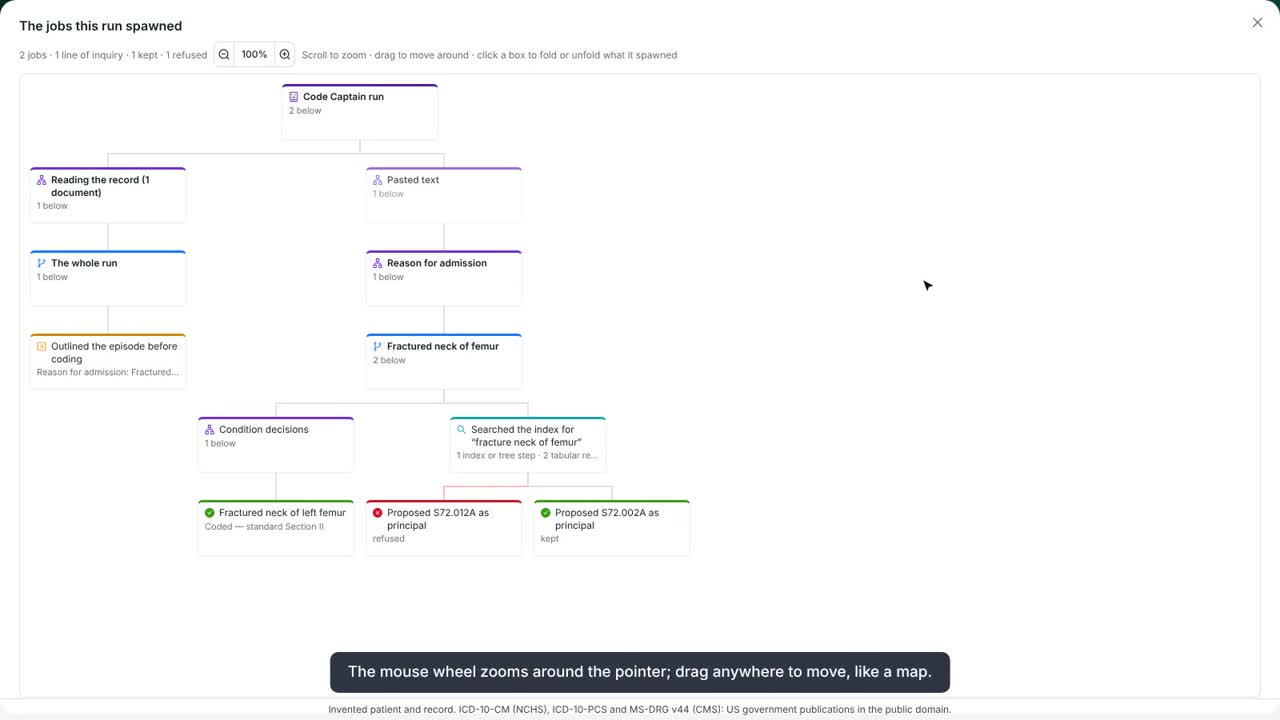
Code Captain reads an episode’s documents and proposes the codes, each traced through the Alphabetic Index and Tabular List to the sentence it came from. Its codes land in this worksheet for you to accept, change or reject. It needs no training set, and comes with Code Navigator.
Try the Code Navigator and Code Captain.
Tech previewBoth run in the HealthOS app. Sign up there to start coding; the tech preview is free for now.
De-identified in your browser, before anything is sent
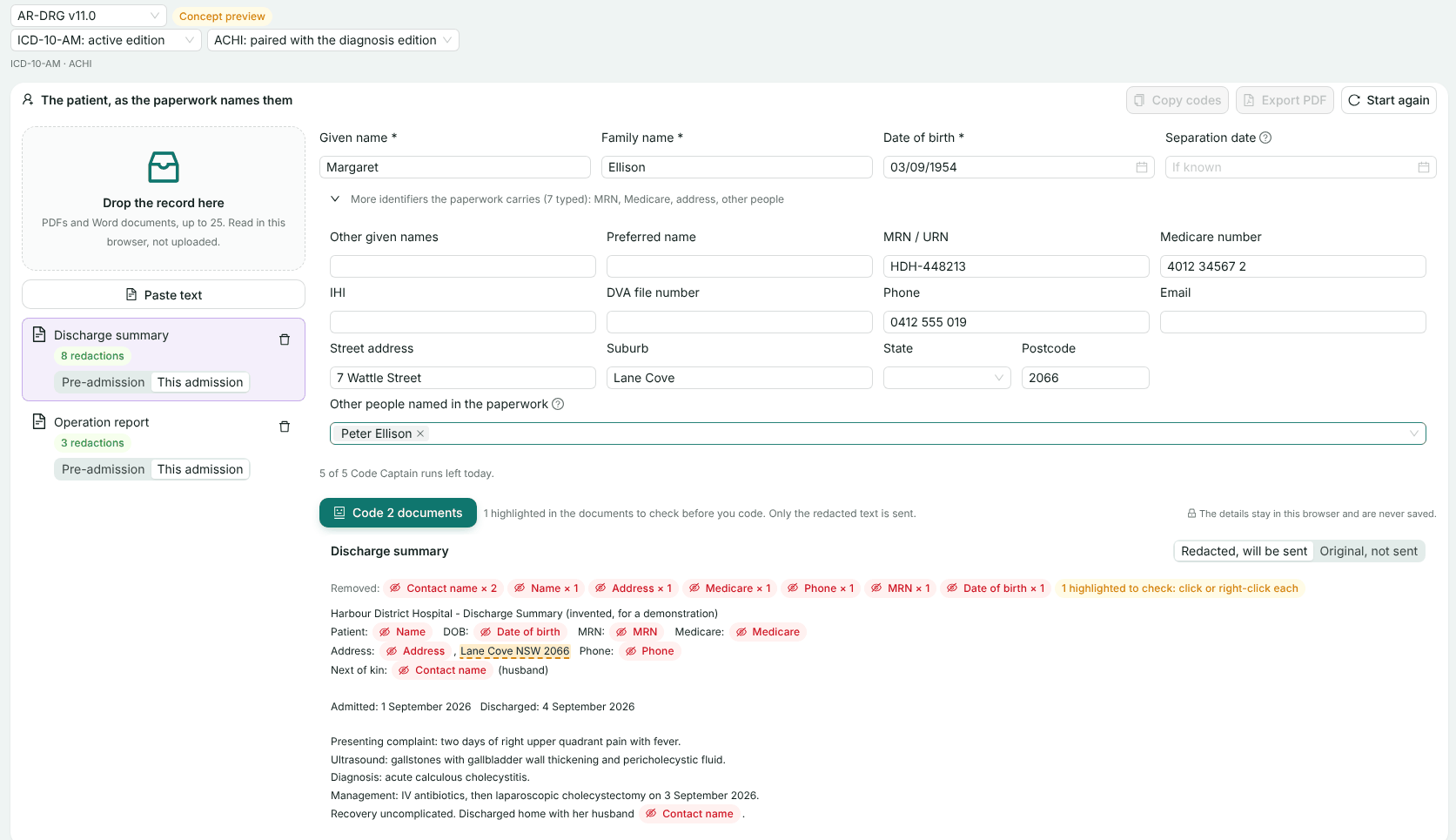
When you upload a discharge summary or an operation report, your browser reads the PDF itself, using text recognition for scanned pages, and removes the patient's identifying details before you see a preview. Only the redacted text you approve is sent. The server checks it again and refuses it if an identifier has survived. Your coding is stored in Australia, in a tenancy that the database itself keeps apart from every other subscriber's.
- PDFs read and redacted in the browser, before anything is kept
- A second check on the server, which refuses text with an identifier in it
- Data stored in Australia
- Each subscriber isolated by row-level security in the database
Two ways to subscribe
Code Navigator, at $79 per coder a month, is the manual coder: the Code Navigator, the worklist and the live DRG, without Code Captain. Code Navigator + Code Captain, at $249, adds Code Captain with 200 runs per coder a month, shared across your team, and is in alpha preview. Both start with seven days free of the Code Navigator; Code Captain runs on AI, so while the preview is free each person can start a limited number of runs a day. HealthOS SaaS is in tech preview, free until 1 January 2027 unless we end it earlier, and we will tell you before anything is charged. Teams of about twenty coders or more can buy on invoice. See pricing.
- Code Navigator: the Navigator, worklist, live DRG
- Code Navigator + Code Captain: all of that, plus Code Captain (alpha)
- Prices in Australian dollars, excluding GST
The same coder, reading the whole record
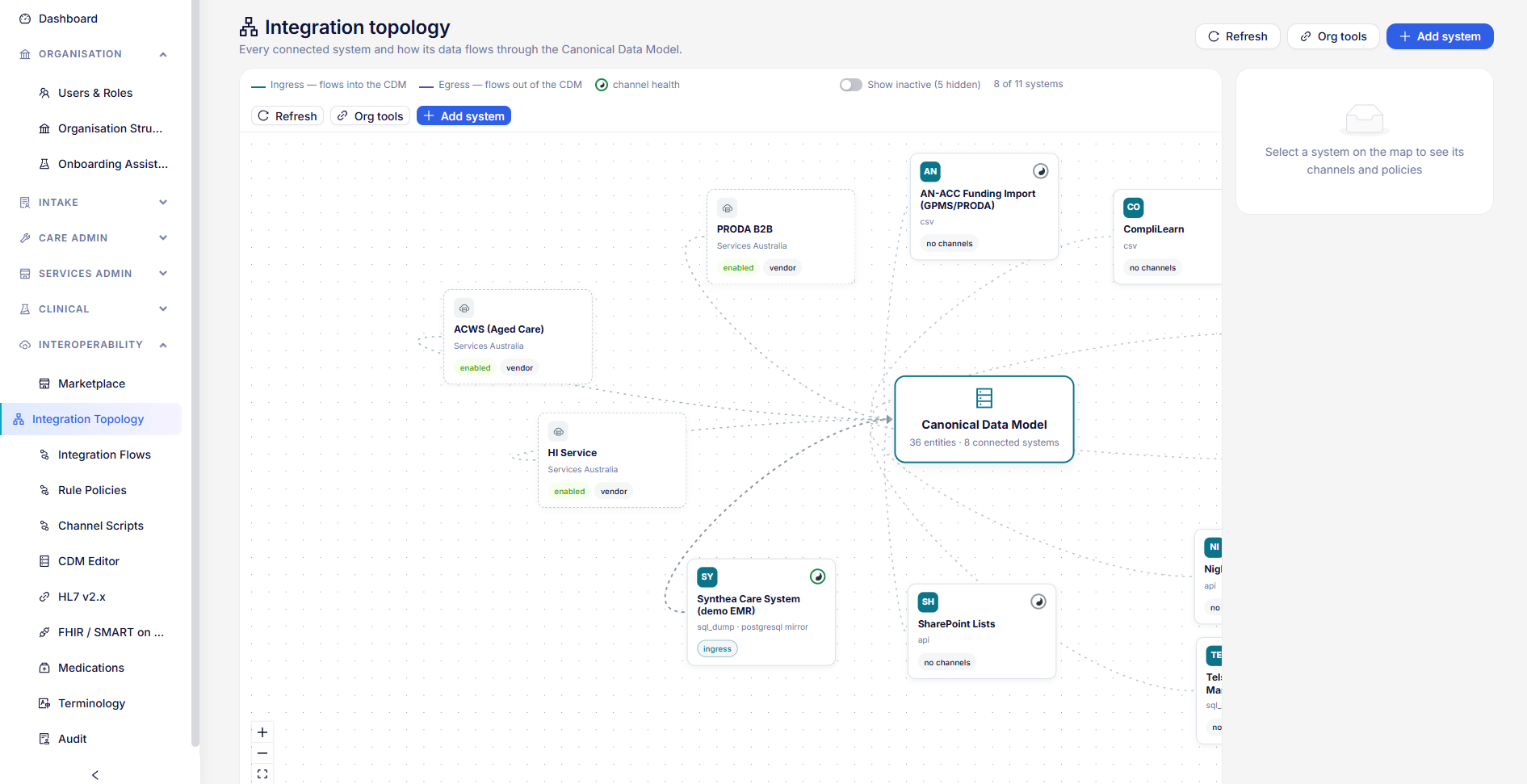
Code Navigator is the coding screen on its own. HealthOS is the record that screen reads from. In a hospital running HealthOS, the coder works from the episode itself: the conditions the patient arrived with are frozen from the pre-admission record at admission, condition onset and hospital-acquired complications come from that comparison, and a finished code set goes on to the claim without being typed again. See clinical coding in HealthOS.
Before you ask
| Question | Answer |
|---|---|
| Who is it for? | Clinical coders, health information managers, contract coding services and coding auditors who want a better coding screen without changing the hospital's systems. |
| Do I need to install anything? | No. It runs in the browser, and there is nothing to connect to your patient administration system. |
| Which classifications are included? | ICD-10-AM and ACHI with AR-DRG grouping for Australian coding, and ICD-10-CM, ICD-10-PCS and MS-DRG for coding in the United States books. The AR-DRG grouper holds IHACPA’s Certificate of Acceptance for AR-DRG Version 11.0 (Code Navigator 1.0, Docker/Linux). |
| Where does my data go? | Your coding, worksheets and audit trail are stored in Microsoft Azure in Australia. When you use Code Captain, the only thing sent to the AI model is the de-identified text you reviewed and approved in your browser, after a second check on our server. During the alpha the model runs on Microsoft Azure's global deployment, so processing can happen outside Australia. Microsoft does not use it to train models; under its Azure OpenAI terms it may keep it for a limited time to monitor for abuse. We are testing an Australia-only deployment for organisations that need processing to stay onshore. |
| What happens if I cancel? | Your access ends. The audit trail of your coding is kept for seven years and stays in your own tenancy. |
| Can I start today? | Yes. Code Navigator is in tech preview: join the tech preview with your work email, no card needed, and nothing is charged before 1 January 2027 (or an earlier end to the preview, which we will tell you about first). |
See it in action
Code your next episode in Code Navigator
Free in tech preview until 1 January 2027. Sign up without a card and start coding today.