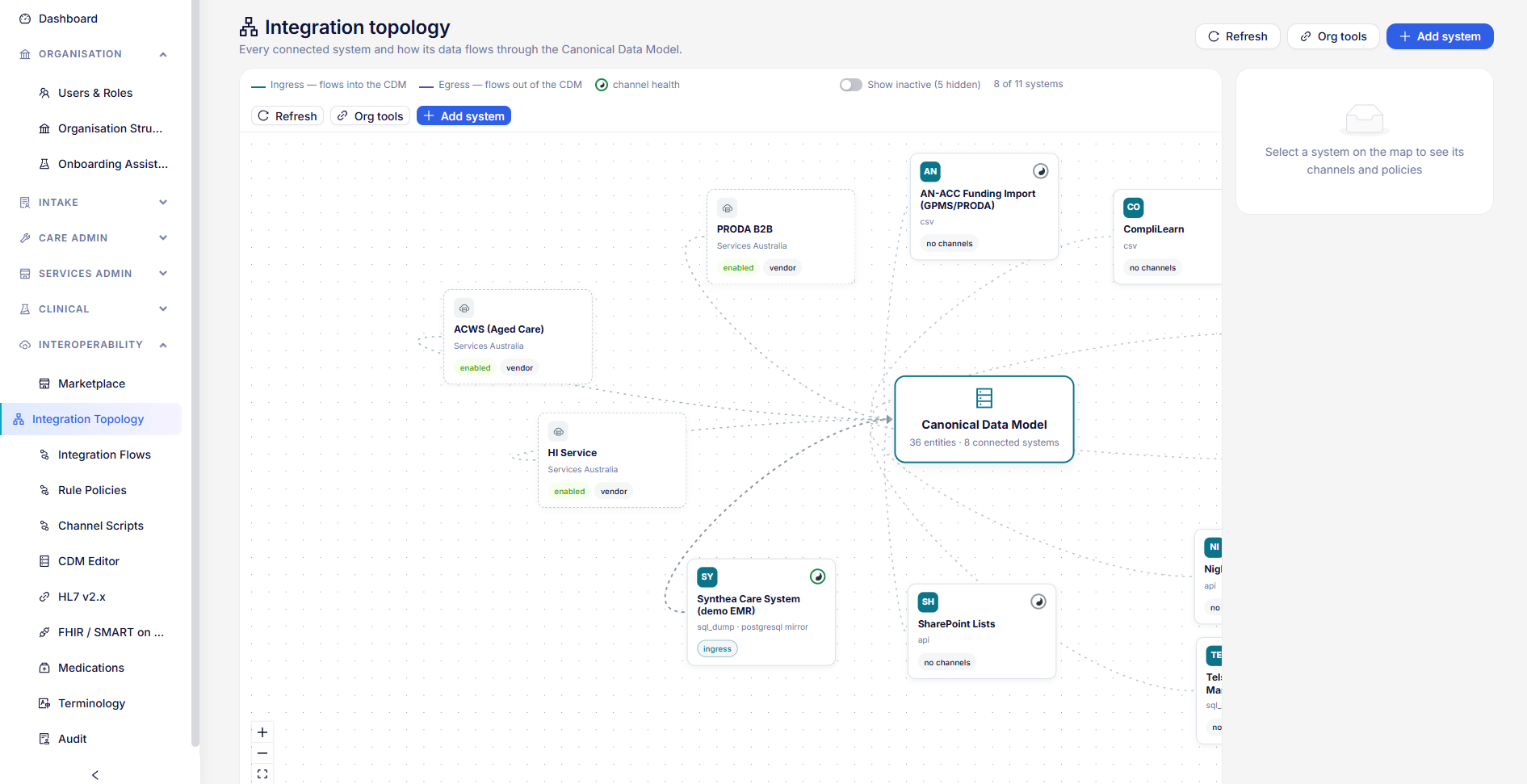
Code Captain: the AI autocoder that shows its working
Give Code Captain an episode’s documents and it codes them the way a coder does. It reads the whole record, looks each condition up in the Alphabetic Index, confirms it in the Tabular List and quotes the record for every code it proposes. You decide which codes stay. Code Captain comes with Code Navigator, so every code opens in the same coding screen.
Alpha preview, free until 1 January 2027. Code Captain is still being finished, so nothing is charged while HealthOS SaaS is in tech preview. Sign up without a card. We may end the preview earlier, and you will hear from us before anything is charged.
An autocoder you can check, code by code
An autocoder that follows the classification, step by step
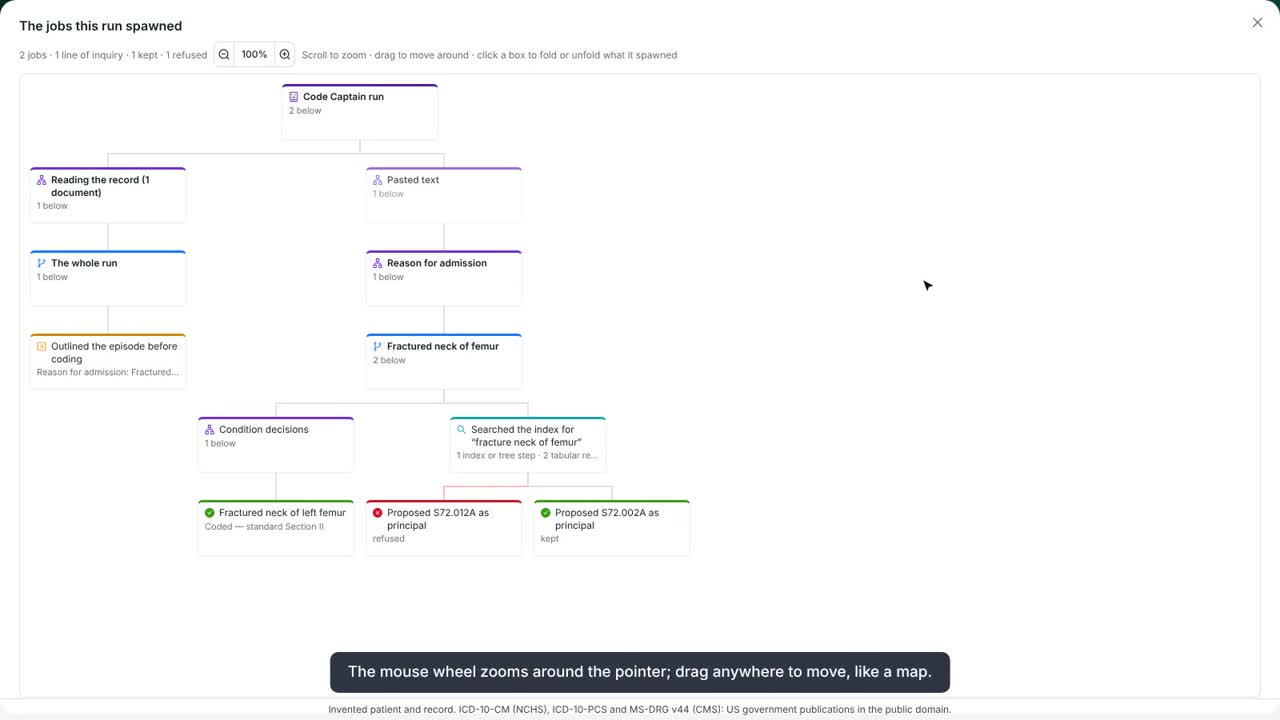
Give Code Captain an episode's documents and it works through them the way the classification is meant to be used. For each condition or procedure it searches the index, follows every cross-reference and verifies the candidate in the tabular list. A code it cannot trace through the index and the tables is dropped, rather than taken from the model's memory. It codes the full picture: a neoplasm's morphology alongside its site, and the external cause of a poisoning or injury. It follows the coding standards for the episode, and flags a diagnosis that is on the hospital-acquired-complications list for you to confirm. Each code it proposes shows the document, the sentence and the path through the classification behind it. Its output is a draft: you accept, change or reject each code, and the grouper re-runs on what you accepted. Clinical interpretation, documentation queries to the clinician and the final code set stay with the coder. Every run is logged.
- Each code traced to its document, sentence and classification path
- The full picture coded: a neoplasm's morphology, a poisoning's external cause, the standards for the episode
- Hospital-acquired complications flagged for you to confirm
- Codes it cannot trace are dropped, not guessed; you accept, change or reject every code
- Every run logged: documents read, codes proposed, codes accepted
No training set. A spread of coded records, and an agentic loop
Many autocoders have to be trained on hundreds or thousands of coded documents before they are any use. Code Captain is not trained at all: it reads the classification itself, the way a coder does. What it needs from you is a spread of records your coders have already coded, across each specialty. Each record is run through Code Captain end to end in an automated browser, and every step it takes is captured: the index searches, the tabular entries it opened and the codes it proposed. An AI agent compares the result with your coders’ codes, finds where Code Captain went wrong, and fixes how it reads, searches and checks, never the answer for that record. Then the records are run again. Round after round, the misses in each specialty are worked out. Others are built on hundreds of hand-written retrieval rules, which still miss. Code Captain’s loop finds the fault in how it reads, searches and checks, and fixes that once, for every specialty.
- No model is trained, so there is no training set to hand over
- A spread of coded records in each specialty is enough to start
- Records are de-identified before they are used
- Every fix is to the method, never a code written in for one record
- Your coders’ codes stay the measure
Every code it proposes lands in the Code Navigator
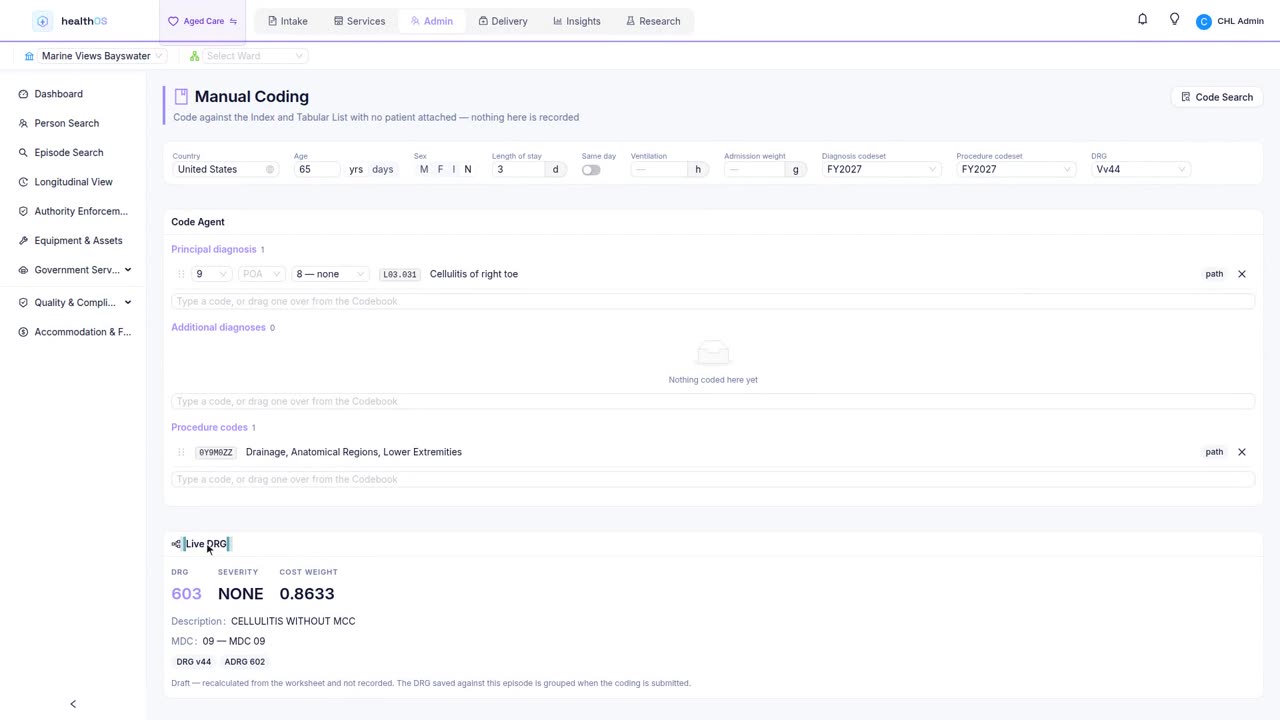
Code Captain comes with Code Navigator, the coding screen it works in. The codes it proposes go into the Code Navigator’s worksheet, where you open each one in the index and tabular list, see what it still asks for and watch the live DRG and the episode’s NWAU update before you accept it. Code Captain itself never sees the DRG, the cost weight or the NWAU: it codes from the record and the classification, not from what an episode is worth. Code Navigator + Code Captain is $249 per coder a month, with 200 Code Captain runs per coder each month, shared across your team, and is free while HealthOS SaaS is in tech preview. See pricing.
- The Code Navigator, the worklist, the live DRG and the episode’s NWAU included
- Code Captain never sees the DRG or NWAU, so it cannot code towards one
- 200 Code Captain runs per coder each month, shared across your team: 5 coders get 1,000 runs between them
- Prices in Australian dollars, excluding GST
De-identified in your browser, before anything is sent
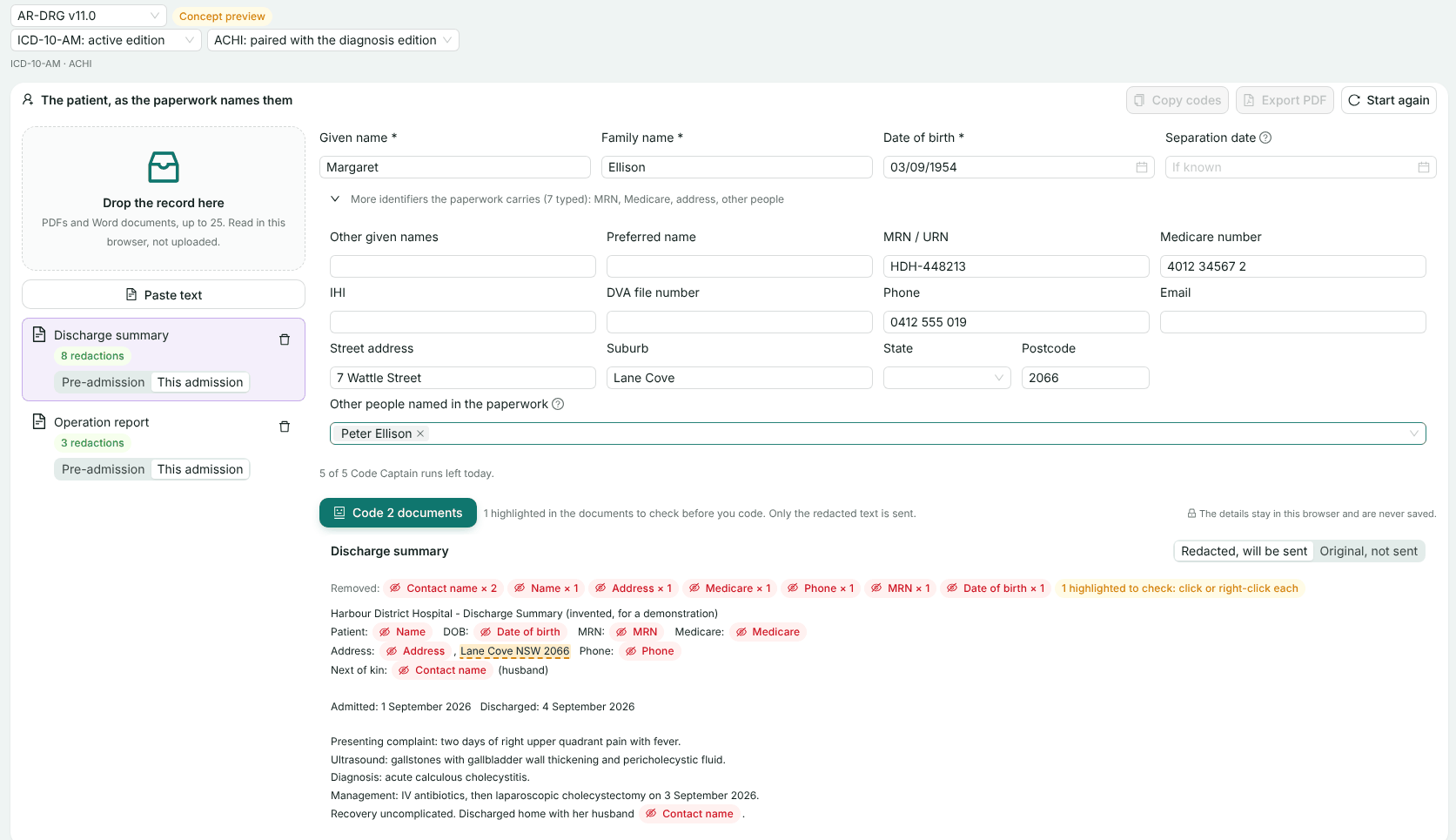
When you upload a discharge summary or an operation report, your browser reads the PDF itself, using text recognition for scanned pages, and removes the patient's identifying details before you see a preview. Only the redacted text you approve is sent. The server checks it again and refuses it if an identifier has survived. Your coding is stored in Australia, in a tenancy that the database itself keeps apart from every other subscriber's.
- PDFs read and redacted in the browser, before anything is kept
- A second check on the server, which refuses text with an identifier in it
- Data stored in Australia
- Each subscriber isolated by row-level security in the database
Before you ask
| Question | Answer |
|---|---|
| Does it need training data? | No. Code Captain does not train a model, so it needs no training set. To fit it to your casemix, we run a spread of records your coders have already coded, de-identified, through Code Captain in an agentic loop, fix how it codes wherever it misses, and run them again. |
| Is the coder still in charge? | Yes. Code Captain’s output is a draft: you accept, change or reject each code, and the grouper re-runs on what you accepted. Clinical interpretation, documentation queries to the clinician and the final code set stay with the coder. Every run is logged. |
| Does it code towards a higher DRG? | No. No DRG, cost weight or NWAU reaches Code Captain: not in what it reads, not in its tools and not in its instructions. It codes what the record documents, following the classification and the coding standards. The DRG and the episode’s NWAU appear afterwards, in the Code Navigator, for the episode as a whole and never beside an individual code. |
| Do I need Code Navigator as well? | It is included. Code Captain is sold as Code Navigator + Code Captain, because the codes it proposes are checked and accepted in the Code Navigator. |
| Which classifications are included? | ICD-10-AM and ACHI with AR-DRG grouping for Australian coding, and ICD-10-CM, ICD-10-PCS and MS-DRG for coding in the United States books. The AR-DRG grouper holds IHACPA’s Certificate of Acceptance for AR-DRG Version 11.0 (Code Navigator 1.0, Docker/Linux). |
| Where does my data go? | Your coding, worksheets and audit trail are stored in Microsoft Azure in Australia. When you use Code Captain, the only thing sent to the AI model is the de-identified text you reviewed and approved in your browser, after a second check on our server. During the alpha the model runs on Microsoft Azure's global deployment, so processing can happen outside Australia. Microsoft does not use it to train models; under its Azure OpenAI terms it may keep it for a limited time to monitor for abuse. We are testing an Australia-only deployment for organisations that need processing to stay onshore. |
See it in action
Let Code Captain code your next episode
Free while HealthOS SaaS is in tech preview. Tell us what you code and in which books.